Gamma brainwaves are fast neural rhythms, roughly 30 to 100 Hz, studied in connection with attention and memory. The Memory Wave's seller says its audio targets the gamma range. That is a design claim: it is not evidence that listening raises gamma activity in your brain, and research on gamma does not prove that a commercial audio program improves memory.
What are gamma brainwaves?
Your brain's cells communicate with electrical signals, and groups of them tend to fire in repeating patterns called neural oscillations. Researchers sort these rhythms into bands by speed: delta, theta, alpha, beta and gamma. Gamma is the fastest of the commonly named bands. It is measured with tools such as EEG (electrodes on the scalp) and, in animal research, with electrodes placed in brain tissue.
Gamma brainwave frequency
| Band | Approx. range | Commonly linked with |
|---|---|---|
| Delta | 0.5 to 4 Hz | Deep sleep |
| Theta | 4 to 8 Hz | Drowsiness, deep relaxation |
| Alpha | 8 to 12 Hz | Relaxed wakefulness |
| Beta | 12 to 30 Hz | Active thinking |
| Gamma | 30 to 100 Hz | Attention and information processing |
The 40 Hz point often mentioned in articles about gamma sits inside this band. The seller of The Memory Wave describes its audio as aimed at the gamma range; we have not measured the actual frequencies in the files.
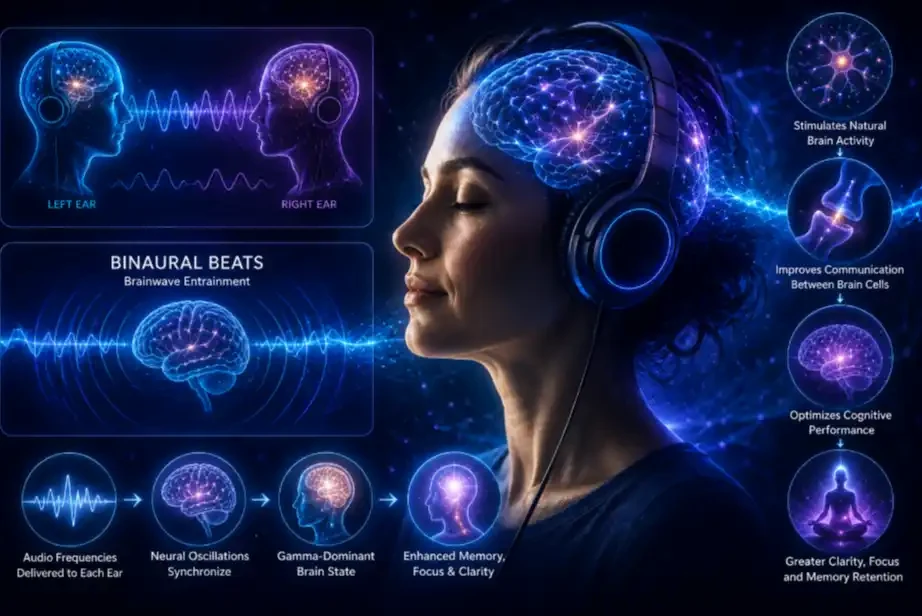
Gamma activity and cognitive processes
Research Reviews of gamma oscillations, such as Buzsáki and Wang (2012), describe how these fast rhythms arise from interactions between groups of neurons and why they are of interest for how the brain coordinates activity. In the wider literature, gamma-band activity is associated with attention, perception and working memory tasks. “Associated with” is the key phrase: it describes correlation observed during tasks, not proof that increasing gamma activity improves performance.
The Memory Wave's gamma-related claims
From the seller's pages, as reflected in our review:
- The audio uses binaural beats and isochronic tones aimed at the gamma range. Vendor
- Listening is meant to support focus, memory and mental clarity. Vendor
- Some seller material goes further, suggesting effects such as clearing metabolic waste or protein build-up and reducing cognitive decline. Vendor
We do not repeat the last claim as fact. It is drawn from laboratory work with other stimuli, as explained next.
What neuroscience research says
Research The most cited gamma-stimulation work comes from MIT's Picower Institute. In a 2016 Nature paper (Iaccarino et al.), flickering light at 40 Hz in mouse models of Alzheimer's disease was reported to reduce amyloid levels and change microglia, the brain's immune cells. Later work from the same group extended to combined light and sound in mice and to early human studies using dedicated devices. In an interview with NeurologyLive, lead researcher Li-Huei Tsai has described the early human results as not sufficient to show efficacy (see sources).
What this research does not show: that headphone audio alone produces the same effects, that healthy adults gain memory benefits, or that any consumer audio product replicates the study conditions.
Gamma brainwaves and memory
Gamma rhythms feature in theories of how the brain binds information together and holds it briefly in mind. A theory about why gamma matters is not the same as a demonstrated way to improve recall on demand. Memory also depends heavily on sleep, stress, attention, health, age and how information is learned. An audio track would be only one small input, if it contributes at all.
Audio stimulation and brainwave entrainment
Entrainment is the idea that brain rhythms may synchronise with a rhythmic external stimulus. It is a documented phenomenon in some experimental setups, such as steady-state responses to flickering lights or repeated tones recorded on EEG. The open question for consumer audio is whether a listening session at home produces meaningful, lasting, useful changes, and whether those translate into better thinking. Reviews describe the evidence as mixed.
Binaural beats explained
When each ear receives a slightly different pure tone, the brain perceives a third, pulsing sound at the difference between the two. For example, 400 Hz in one ear and 440 Hz in the other would be perceived as a 40 Hz beat (an illustration only, not the product's settings). Headphones are required.
Research A 2023 systematic review and meta-analysis in Psychological Research (Basu and Banerjee) reported a near-moderate overall effect of binaural beats on memory and attention, while noting mixed findings across studies and calling for more robust research. A 2024 review in Basic and Clinical Neuroscience (Mirmohamadi et al.) surveys what is known about binaural beats and the brain. Studies differ in frequencies used, task type, duration and design, so results from one cannot be assumed for another, including this product.
Limitations of brainwave audio
- Frequency in the file is not frequency in the brain. A track can contain a 40 Hz element without anyone measuring a corresponding change in a listener's EEG.
- Individual variation. People differ in how they respond, and expectation can shape how people feel.
- Short sessions, uncertain persistence. Even where effects are reported, they are often short-lived and measured in controlled lab tasks.
- Heterogeneous studies. Meta-analyses mix different designs, which limits firm conclusions.
- Safety. People with epilepsy or sensitivity to rhythmic stimuli should seek advice first.
Product claims versus scientific evidence
| Claim | Evidence level |
|---|---|
| Gamma rhythms exist and are studied in relation to attention and memory | Well established as a research topic Research |
| Binaural beats can modestly affect memory/attention in some studies | Encouraging but mixed Research |
| 40 Hz light/sound reduces Alzheimer's-related markers | Mouse studies; early human work with dedicated devices Research |
| The Memory Wave audio raises gamma activity in listeners | No independent measurement found Unverified |
| The Memory Wave improves memory | No independent clinical trial found Unverified |
| Headphone audio clears protein build-up or slows cognitive decline | Not shown Unsupported |
For our overall assessment, read Does The Memory Wave really work?. For the product itself, see the overview.
Frequently asked questions
What are gamma brainwaves?
Fast neural oscillations, commonly described as roughly 30 to 100 Hz, studied in connection with attention, perception and memory-related tasks.
Does The Memory Wave use gamma frequencies?
The seller says its audio is aimed at the gamma range. We have not measured the files, and there is no independent confirmation of the exact frequencies or of any effect on listeners' brain activity.
Does listening to gamma audio increase gamma brainwaves?
Entrainment has been observed in some experiments, but it is not established that home listening to a given consumer track does so in a meaningful or lasting way.
What are binaural beats?
A perceived pulsing created when each ear hears a slightly different tone through headphones. The beat is at the difference between the two tones.
Is the MIT 40 Hz research about The Memory Wave?
No. That work used light and sound in mice and early human studies with dedicated devices. It did not test this product.
Is gamma audio safe?
Calm audio at a comfortable volume is low-risk for most adults, but people with epilepsy, seizure history, tinnitus or sensitivity to rhythmic sound should check with a healthcare professional first.
Check the current offer yourself
Prices, bonuses and refund terms are set by the seller and can change. Read the seller's own terms before you pay.
Commercial affiliate link: this site may earn a commission at no extra cost to you. You leave this site when you click. See our affiliate disclosure.
Related guides
Sources and references
- Buzsáki G, Wang XJ. (2012). Mechanisms of gamma oscillations. Annual Review of Neuroscience. PubMed 22443509.
- Iaccarino HF, et al. (2016). Gamma frequency entrainment attenuates amyloid load and modifies microglia. Nature. PubMed 27929004. A study in mice.
- Basu S, Banerjee B. (2023). Potential of binaural beats intervention for improving memory and attention: insights from meta-analysis and systematic review. Psychological Research. PubMed 35842538.
- Mirmohamadi S, Norozpour Y, Zarrabian S. (2024). A Review of Binaural Beats and the Brain. Basic and Clinical Neuroscience. PMC11367212.
- MIT Picower Institute: 40Hz rhythms and Alzheimer's research overview.
- NeurologyLive interview with Li-Huei Tsai on gamma frequency sensory stimulation.
Disclosure: this is an independent affiliate review site, not the seller. We may earn a commission if you buy through our links. We have not tested the audio ourselves. This page is general information, not medical advice. See the disclaimer and affiliate disclosure.